Hybrid Tool + ReportUpdated 2026-07-26

12V DC Lead Screw Motor Sizing Tool

Use this canonical lead screw motor page to calculate linear speed and thrust for 12V DC, Stepper, and BLDC architectures. Verify fit and identify limits before committing to hardware.
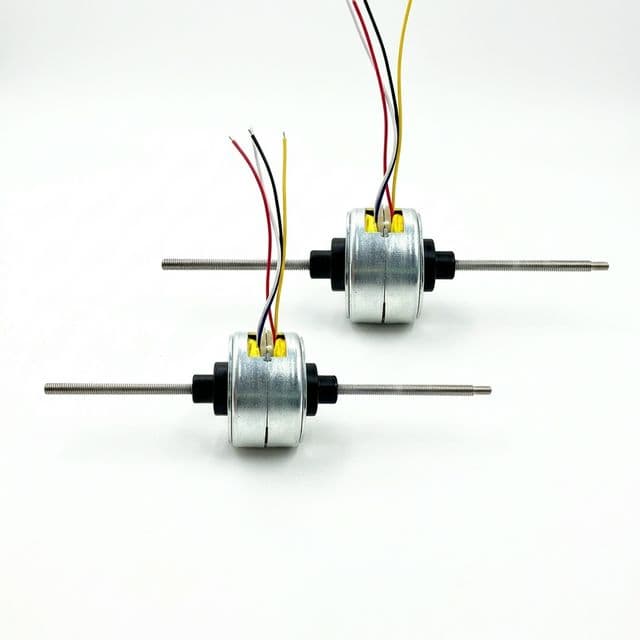
12V DC lead screw motor with through-shaft lead screws for linear actuator sizing

Input Parameters

Architecture

Boundary: 3V to 48V. A 12V DC lead screw motor should normally stay near 11V-13.2V unless the datasheet allows a wider range.

Boundary: 0.5mm/rev to 25mm/rev. Higher lead increases linear speed and reduces thrust margin.

Boundary: 10 rpm to 6,000 rpm at the screw input. High speed still needs screw critical-speed verification.

Boundary: 0.1kg to 80kg vertical-equivalent load. Heavy loads need static and dynamic safety-factor checks.

This quick screen assumes vertical load. If the result is inconclusive, use the engineering review path instead of forcing a procurement decision.

Configure parameters on the left and run the tool to view linear speed and thrust outputs.

Key Conclusions & Market Data

Executive summary of architecture limits based on traceable source notes and conservative sizing formulas.

12V DC Brushed is the lowest-cost entry point for simple tasks

For simple point A to B linear motion, a 12V DC lead screw motor minimizes BOM cost and driver complexity. It should be treated as conditional when the job needs continuous holding, exact intermediate positioning, or long unattended service life.

Stepper motors excel at open-loop positioning and repeatability

If the application requires repeatable millimeter positioning, a NEMA stepper with a lead screw is usually a cleaner architecture than a basic DC motor. The tradeoff is driver complexity, current-limit setup, heat, and torque drop at higher speed.

Lead pitch dictates the speed-thrust tradeoff

A smaller lead (e.g., 2mm) provides higher mechanical advantage (more thrust) but limits linear speed. An 8mm lead moves 4x faster but provides 1/4 the thrust for the same motor torque.

Efficiency heavily impacts total thrust (Self-Locking vs Ball Screws)

Trapezoidal or Acme lead screws trade efficiency for friction and holding resistance. The page uses a 20-40% efficiency band so the result does not overstate thrust before the exact screw/nut material and lubrication are known.

Linear Motion Kinematics

12V DC motor driving a lead screw and nutDiagram showing a motor rotating a lead screw so the nut moves linearly according to screw lead and RPM.12V DC MotorNutLinear Speed (v)RPM

The rotational speed (RPM) is converted into linear speed (v) by the lead screw nut. Lead defines linear travel per revolution.

Methods and Evidence Base

The equations and limits used in this tool.

TopicValue / FormulaNote
Lead Screw Efficiency (Trapezoidal)20% – 40% for Acme power screwsUse 20-40% as a conservative torque-sizing band before supplier-specific efficiency is known.
Brushed DC Life Boundary1,000-5,000 h under typical FAULHABER load conditionsBrush and commutator wear are load, speed, duty-cycle, and environment dependent; this is not a warranty value.
Stepper / BLDC Life BoundaryUsually bearing and grease limitedOriental Motor and FAULHABER both frame non-brushed life around bearing grease, temperature, radial load, and duty cycle.
Thrust CalculationFa = 2π * η * T / leadThe tool reverses this equation to estimate required motor torque for the entered load and lead.

Architecture Comparison, Risks, and Scenarios

Use the tool output as a first screen, then decide whether 12V DC, stepper, or BLDC is the right lead screw motor path.

Architecture Decision Table
The alias keyword is answered here: a 12v dc lead screw motor is an architecture option inside the canonical lead screw motor page, not a separate route.
ArchitectureBest fitAvoid whenNext action
12V DC brushed lead screwLow-cost point-to-point travel with end switches or a simple position sensor.Continuous holding, high duty cycle, exact open-loop positioning, or long maintenance-free life is mandatory.Specify voltage range, gearbox ratio, lead, limit-switch logic, and expected starts per hour.
NEMA stepper lead screwRepeatable positioning with deterministic step counts and moderate speed.Very high linear speed, limited driver space, strict heat budget, or battery-only operation dominates.Check pull-out torque at target rpm and derate for driver current, temperature, and acceleration.
BLDC lead screw actuatorHigh duty cycle, long life target, and closed-loop speed or position control.Prototype budget cannot absorb 3-phase driver, encoder, firmware, or validation work.Define control loop, encoder resolution, thermal path, and production volume before RFQ.
Risk Matrix
Concrete failure modes with mitigation steps before RFQ or prototype release.

Misuse risk

Trigger: Treating a 12V DC lead screw motor like an open-loop positioning axis.

Mitigation: Add limit switches, Hall/encoder feedback, or move the design to a stepper/servo architecture.

Cost risk

Trigger: Choosing BLDC or closed-loop stepper before tolerance and life targets are confirmed.

Mitigation: Prototype with the lowest architecture that satisfies speed, thrust, duty, and position evidence.

Scene mismatch risk

Trigger: Relying on generic thrust math for a long vertical screw or shock-loaded lift.

Mitigation: Validate buckling, critical speed, end support, anti-backdrive brake, and real screw/nut efficiency.

ScenarioAssumptionLikely fit
Small latch or vent actuator12V supply, short stroke, end-to-end travel, intermittent use.12V DC brushed lead screw with limit switches and conservative stall-current margin.
Printer or lab Z-axisRepeatable mm positioning, moderate speed, known load, frequent movements.NEMA stepper lead screw after pull-out torque and thermal checks at the chosen rpm.
Long-life medical or industrial pumpHigh duty cycle, auditable movement, low maintenance, controlled load path.Stepper with feedback or BLDC actuator; supplier datasheet validation required before release.

Frequently Asked Questions

B2B fit, OEM scope, and inquiry handoff

Use this standard block to align page decisions with factory-side execution before RFQ launch.

Application fit
Projects that match this page's pre-RFQ scope.
  • Medical syringe pumps (12V brushed)
  • Z-axis 3D printing (NEMA steppers)
  • Robotic grippers and linear actuators
OEM options
Customization knobs available from factory-side engineering.
  • Custom screw leads (1mm to 8mm+)
  • Teflon coated lead screws for noise reduction
  • Integrated anti-backlash nuts
Trust and compliance
Evidence gates required before production commitment.
  • ISO 9001:2015 factory certified
  • RoHS and REACH compliant materials
  • 100% End-of-line load testing