Sourcing Autoclavable Coreless DC Motors for Surgical Hand Tools: Cycle Life, Sealing, and Compliance (2026 Guide)
Coreless DC motor sourcing guide for autoclavable surgical hand tools. Validate cycle life, sealing, compliance evidence, and RFQ risks before supplier review.
One-Line Decision: When sourcing coreless DC motors for reusable surgical power tools, do not accept generic "MTBF" or "medical grade" claims; demand Weibull analysis based on simulated steam-sterilization (autoclave) cycles (e.g., 134°C, 100% humidity, 2.1 bar) specific to your tool's duty profile.
This guide provides a decision-grade framework for procurement managers and motion-control engineers evaluating coreless motor suppliers in the medical and surgical device sector, focusing on the latest standards and failure mitigations in 2026.
Scope and limits: This article applies to reusable surgical hand tools and sealed drive modules exposed to repeated steam sterilization. It does not cover single-use instruments, non-sterile lab automation, or motors isolated from steam by a validated disposable sterile barrier. Treat all cycle-life numbers below as RFQ screening thresholds until your supplier proves them with tool-specific validation data.
The State of Autoclavable Drives in 2026
The shift towards robotic-assisted surgery and battery-operated orthopedic hand tools has placed unprecedented thermal and environmental demands on micro-motors. Standard coreless DC motors—even those marketed as "medical grade" for pumps or ventilators—will fail rapidly when exposed to the harsh conditions of hospital sterilization departments.
What Has Changed Recently?
| Market / Standard Shift | Procurement Impact | Engineering Impact |
|---|---|---|
| Increased Cycle Life Demands | Hospitals now expect 2,000 to 3,000+ autoclave cycles before tool refurbishment, up from the historical 1,000-cycle baseline. | Component selection must shift to advanced potting compounds and specialized bearing greases that resist repeated wash-down. |
| IEC 60601-1 / MDR Scrutiny | Regulatory bodies in the EU and US are demanding tighter traceability on component-level validation. | Supplier evidence packages must include raw data from accelerated life testing (ALT) under load, not just static oven baking. |
| Brushless (BLDC) Dominance | Brushed coreless motors are being phased out of high-end reusable surgical tools. | Sourcing teams must evaluate the entire drive package (Motor + Autoclavable Hall Sensors + Sealed Gearhead). |
Why Standard Coreless Motors Fail in Autoclaves
To understand what to specify in your RFQ, you must understand the failure modes of standard motors inside an autoclave (typically 134°C / 273°F for 18 minutes, 100% relative humidity, under pressure).
- Grease Washout & Bearing Seizure: High-temperature steam penetrates standard bearing shields, melting or washing away standard lubricants. The bearing corrodes and seizes on the next spin.
- Insulation Breakdown (Electrical Short): Moisture breaches the motor housing. Standard winding varnish absorbs water, leading to a catastrophic short circuit across the coils or to the housing.
- Magnetic Demagnetization: NdFeB (Neodymium) magnets lose their magnetic flux if exposed to high temperatures without proper grade selection (e.g., specifying high-temp SH or UH grades).
- Galvanic Corrosion: Dissimilar metals in the housing, shaft, and flange create a battery effect in the presence of saline or high-humidity steam, deteriorating the structure.
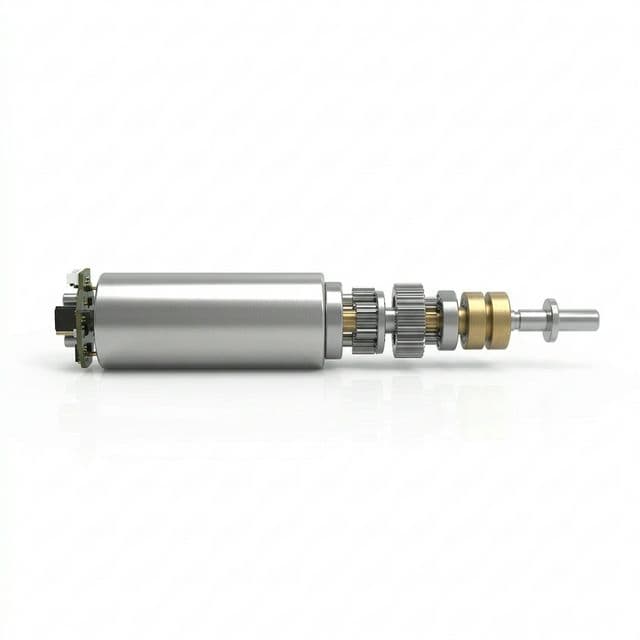
Visualizing the Autoclavable Coreless Architecture
Anatomy of an Autoclavable Sourcing Spec
When evaluating a supplier's datasheet or drafting a custom RFQ, ensure these specific material and design choices are documented:
| Component | Standard Commercial Spec | Required Autoclavable Medical Spec | Sourcing Risk if Ignored |
|---|---|---|---|
| Housing / Casing | Aluminum or standard steel | 316L or 17-4 PH Stainless Steel, laser welded. | Rapid oxidation, ingress of steam through micro-gaps, leading to electrical shorts. |
| Windings | Basic enamel/varnish | Full epoxy encapsulation (potting) of the stator. | Steam penetrates the coil, causing inter-turn shorts and immediate motor death. |
| Bearings | Standard lithium grease | High-temp, moisture-resistant fluorinated grease with specialized radial shaft seals. | Bearing seizure is the #1 cause of failure in surgical motors. |
| Magnets | N35-N45 (Standard) | High-temperature grades (e.g., SmCo or N45SH/UH) | Heat from the autoclave permanently degrades the magnetic field, resulting in permanent torque loss. |
| Connections | Soldered wires | Glass-to-metal sealed pins or highly specialized molded silicone cables. | Steam wicking up the cable jacket directly into the motor cavity. |
| Sensors / PCB | Open Hall board or commodity sensor package | Encapsulated Hall sensors and high-temperature PCB materials rated above the sterilization peak. | A mechanically sealed motor can still fail electrically if sensor electronics absorb moisture or drift after repeated thermal shock. |
How to Evaluate Supplier "MTBF" and "Cycle Life" Claims
The most dangerous pitfall in sourcing medical motors is accepting a marketing claim like "Withstands 1,500 Autoclave Cycles" without examining the test methodology.
An idle motor baked in an oven is not an accurate simulation of a surgical tool's lifecycle.
The Procurement Audit Framework
To validate a supplier, demand answers to these questions:
- Was the test static or dynamic? Poor: The motor was autoclaved 1,000 times without being run. Excellent: The motor was run under a simulated surgical load (e.g., bone drilling torque profile) for 5 minutes, then autoclaved, and repeated for 2,000 cycles.
- What was the failure criteria? Did the supplier define failure as "the motor stopped spinning," or did they measure performance degradation (e.g., "efficiency dropped by >10%", "noise increased by >5dB")?
- Do they provide Weibull Analysis? Do not accept a single "Average Life" number. Demand a Weibull plot showing the B10 life (the point at which 10% of the sample population failed) to accurately model warranty risk for your surgical device.
Sourcing and Engineering Checklist
Use this checklist during your supplier evaluation and RFQ phase to prevent costly design iterations late in the medical device development cycle.
- Define the Cycle Profile: Document the exact temperature (e.g., 134°C / 137°C), duration (e.g., 18 mins), and chemical detergents (pH levels) used in the target hospital washdown process.
- Specify BLDC: Ensure the motor is Brushless DC (Coreless/Ironless EC). Brushed motors cannot be fully sealed effectively for long-term autoclave survival.
- Verify Hall Sensor Limits: If using a sensored motor, confirm the Hall effect sensors and their PCB are rated for >140°C and are fully encapsulated.
- Audit the Gearbox: If a planetary gearhead is attached, ensure it features the same autoclave-rated grease and sealing as the motor. A surviving motor attached to a seized gearbox is useless.
- Request ALT Data: Request Accelerated Life Testing (ALT) reports specifically cross-referencing autoclave exposure with dynamic mechanical loading.
- Review NRE Costs: Custom autoclavable motors often require significant Non-Recurring Engineering (NRE) tooling for specific seals, laser welding fixtures, and potting molds. Budget for this early.
FAQ: Sourcing Autoclavable Micro-Motors
Can I just use a standard coreless motor and seal the surgical tool's outer housing?
This is extremely risky. Surgical tool outer seals (like O-rings on the handpiece) degrade over time. If a single drop of condensation bypasses the outer seal, a standard motor will fail. Medical OEMs prefer "belt and suspenders"—a sealed tool housing and an autoclavable motor.
Why do some suppliers use Samarium Cobalt (SmCo) magnets instead of Neodymium (NdFeB)?
While NdFeB is stronger at room temperature, SmCo has vastly superior temperature stability and corrosion resistance. It will not demagnetize as easily during repeated 134°C autoclave cycles.
How much more expensive are autoclavable coreless motors compared to standard ones?
Expect a price multiplier of 3x to 5x over a standard industrial coreless motor of the same size. The cost is driven by the exotic materials (fluorinated grease, high-temp epoxy, stainless steel), tight tolerances required for laser welding, and lower production yields.
What is the lead time for custom surgical motors?
In 2026, initial prototyping for a custom-sealed autoclavable motor typically takes 12 to 16 weeks. Production lead times run 16 to 24 weeks due to the specialized sourcing of medical-grade bearings and potting compounds.
Conclusion and Next Steps
Specifying a coreless DC motor for an autoclavable surgical hand tool is a high-stakes engineering and procurement decision. The upfront cost of a properly encapsulated, laser-welded BLDC motor is insignificant compared to the cost of a medical device recall or a hospital rejecting your product due to premature failure.
Stop relying on generic spec sheets. Force your potential suppliers to prove their lifecycle claims with dynamic testing data.
Ready to evaluate a reliable drive solution for your next surgical device? Our engineering team can help you navigate the trade-offs between cycle life, torque density, and cost. Contact our application engineers to request a detailed review of your medical coreless DC motor requirements and validation data needs.
Sources
- maxon group: "Drives for Surgical Systems" - Supplier reference for fully sterilizable drive systems, hermetic sealing, and autoclave cycle claims. (maxongroup.com)
- CDC Infection Control: "Steam Sterilization" - Reference for steam sterilization methods, exposure parameters, monitoring, and healthcare reprocessing context. (cdc.gov)
- U.S. FDA Guidance: "Reprocessing Medical Devices in Health Care Settings: Validation Methods and Labeling" - Regulatory reference for reusable medical device reprocessing validation. (fda.gov)
Author
Categories
More Posts
Coreless DC Motor EMI Suppression: Factory-Integrated vs. External Mitigation Costs (2026)
Use this 2026 coreless DC motor EMI sourcing guide to compare factory varistors, LC filters, and external PCB mitigation costs for IoT and medical RFQs.

RFQ Checklist for Coreless DC Motor OEM Projects
A practical RFQ checklist to speed up technical alignment, quoting, and sample planning for custom coreless DC motor sourcing.
Coreless DC Motor Market Update (2026-W20): Tariff Review Windows, Drive-Safety Compliance, and Sourcing Decisions
A decision-grade update for motion-control and procurement teams on new U.S. Section 301 review windows, IEC 61800-5-1 implementation signals, and supplier-side changes affecting high-speed coreless DC motor programs.